Sunday, February 6, 2011

Mesir Negara Ramai Ulamak Gagal Mendisiplinkan Rakyat Dan Pemimpin Tidak Seperti Malaysia


Mesir negara peradaban awal. Tamadun yang membina piramid. Negara para anbiya nabi Musa dan Firaun. Negara moden pusat kebudayaan Arab dan Islam. Negara yang mempunyai institusi agama yang masyhur dan tertua di dunia Universiti Al-Azhar, Kaherah melahirkan ramai ulamak gred A bertaraf dunia.

Mesir negara yang punya ramai ulamak tersohor gagal mendisiplinkan rakyat dan pemimpinnya dari menghuruharakan negara. Mesir sudah tidak aman, tidak stabil politiknya. Keadaan menjadi kelam kabut bila harga makanan dan bahanapi melambung naik dan bekalan terhad, semua orang membawa parang, pisau, pedang, kayu dan apa-apa sebagai langkah keselamatan. Kedai-kedai dan pasarraya dijarah. Bank-bank ditutup dan rakyat tidak bekerja.

Keadaan politik dan ekonomi Mesir terutama di bandar-bandar besar yang kacau ini membuatkan Mesir tidak lagi selamat didiami oleh rakyat asing dan pelancung. Rakyat Malaysia umpamanya terutama pelajar telah dan sedang dibawa pulang oleh kerajaan Malaysia yang diketuai oleh DS Najib yang sangat bimbang terhadap keselamatan pelajar muda Malaysia maka operasi piramid membawa pulang 11,000 pelajar Malaysia dijalankan.

Mesir negara yang punya ulamak gred A dunia ternyata gagal membendung krisis Mesir. WZWH tidak mahu menyalahkan kerajaan Hosni Mubarak yang tidak mendengar suara rakyat atau protes rakyat yang inginkan perubahan telah menghuruharakan keadaan.

Krisis Mesir bermula selepas krisis tunjuk perasaan rakyat Tunisia yang berjaya mengulingkan presidennya telah menghasilkan gelombang memberi kesan kepada banyak negara Arab lain di Timur Tengah. Amerika Syarikat dibawah pentadbiran Obama telah pening kepala tidak tahu dan tidak jelas serta kabur untuk menyokong mana-mana pihak demi kepentingan Amerika.

Amerika takut Mesir menjadi republik Islam Iran. Amerika mahu sokong pemimpin yang dihasilkan melalui rundingan Mubarak dan rakyat memberontak. Muhammed ElBaradei telah memberi amaran kepada Amerika supaya jangan campur tangan.

WZWH boleh buat kesimpulan sebenarnya Malaysia lah negara Islam di dunia yang patut menjadi ikutan negara Islam atau negara umat Islam. Malaysia walaupun tiada ulamak bertaraf dunia @ gred A tetapi ulamak Malaysia dan pemimpin UMNO berjaya memerintah Malaysia mengikut Al-Quran dan Sunnah meskipun PAS tidak bersetuju dan mengakui.

Malaysia negara yang dirahmati oleh Allah dan para Anbiya dan Wali Allah kerana negara ini sejak merdeka 1957 telah berdiri dengan megah, berdikari, membina kerajaan, negara yang aman, makmur, stabil, adil kepada rakyatnya betul-betul mengikut ajaran Islam yang sebenarnya dan berjalan di atas jalan yang lurus.

WZWH cabar mana-mana ulamak dunia Arab bertaraf dunia dan gred A buktikan apa yang WZWH lontarkan ini dan pandangan-pandangan WZWH adalah SALAH!

DS Najib Segera Bina Masjid Baru Kg Kuala Sat Ulu Tembeling


WZWH menyokong penuh posting blog MuaraSat bertajuk "Rayuan Kepada MB Pahang" baca sini, berkenaan masjid Kampung Kuala Sat, Ulu Tembeling, Jerantut, Pahang.

Dalam posting yang lepas WZWH telah menyentuh perkara yang sama, sila baca sini

Masjid Kuala Sat adalah masjid lama dibuat dari kayu pada tahun 1964. Sejak itu hanya peruntukan membaikpulih saja hinggalah keadaan menjadi daif sekarang. Beberapa bah telah merosakkan kayu dan struktur bangunan masjid itu.

Pada mulanya kerajaan negeri Pahang hanya mampu memberi peruntukan sebanyak RM400,000. Ini tidak cukup kerana kos membuat masjid di Ulu Tembeling lebih tinggi. Sebagai contoh bagi model masjid yang boleh memuat kapasiti seramai 700 orang seperti Masjid Kampung Bukit Rang, Pulau Tawar kos masjid ialah sebanyak RM1.9 juta.

Jika kos yang sama diambil sebagai asas maka masjid di Kampung Kuala Sat akan boleh memuatkan kapasiti 300 orang.

Masjid itu perlu dibuat baru di tapak baru. YB Dato' Wan Amizan telah memohon peruntukan sebanyak RM1.9 juta melalui MB Pahang bagi membina masjid baru Kuala Sat. Masjid baru ini dicadang dibina lebih besar kerana penduduk Kampung Jipang di Sungai Sat akan berpindah ke seberang maka untuk memenuhi keperluan penduduk Kuala Sat yang semakin ramai maka peruntukan itu dikira wajar.

MB Pahang telah menulis surat kepada DS Najib memohon peruntukan pembinaan masjid baru Kampung Kuala Sat dengan memberi penjelasan panjang lebar. WZWH percaya DS Najib akan meluluskan permohonan pembinaan masjid baru Kampung Kuala Sat dengan kos hampir RM2 juta.

Hari ini DS Najib telah mengumumkan peruntukan tambahan RM20 juta bagi membesarkan Masjid Jamek Kampung Baru, Kuala Lumpur. Maka peruntukan RM2 juta itu kecil saja bagi DS Najib bagi membina masjid baru Kampung Kuala Sat, Ulu Tembeling.

Status permohonan masjid Kampung Kuala Sat itu masih dalam proses kelulusan. Insyallah tahun 2011 ini kelulusan permohonan ini akan membolehkan pembinaan masjid Kampung Kuala Sat. Pada bulan Jun tahun 2010, Mufti Negeri Pahang bersama Tuan Kadi Jerantut telah mudik ke Kampung Kuala Sat bagi menentukan arah kiblat yang betul di tapak baru.

WZWH harap penduduk Kuala Sat bersabar. WZWH faham orang Tembeling suka bermanja dengan YB Dato' Wan Amizan, ADUN Tahan. Kalau orang Tembeling minta sesuatu dari ADUN Tahan, orang Tembeling mengharapkan esok atau lusa terus boleh lulus.

Friday, February 4, 2011

A Stalemate Egypt, Leaderless Nation And Anarchy State


Egypt is in the middle of an extremely difficult situation where the regime is clinging to the old ways of doing things and offering at best a mixture of mild steps with the possibility of heavy repression. That is not going to work for long. 

It is clear that the political system as it has been configured for the last half-century cannot survive. There is a strong and diffuse challenge from wide segments of Egyptian society and a regime that has no ability—and perhaps no willingness—to respond. 

Protests were sparked by a combination of economic and political reasons—but the dominant concern was undoubtedly political. Egyptians have long been faced with economic constraints, a lack of jobs, and a growing disparity between rich and poor, but there is a strong sense that the economic hardship was caused by the Mubarak regime. There is also a widespread belief that the government hasn’t done anything to remedy the situation. 

We know what the underlying reasons for the uprising are, but it is more difficult to answer why the protests spread now—the conditions have existed in Egypt for twenty years. The upheaval in Tunisia, however, helped embolden Egyptians and demonstrated that a crowd can bring down a president. And protests in Egypt led to a crisis much faster than protests did in Tunisia. 

The least likely outcome is for the regime to continue as is. Had the regime reacted more rapidly and subtly a week ago, it may have been able to placate the opposition with a pledge that Mubarak would not run again. But at this stage it is most likely that the regime will collapse or it will be significantly reconfigured.

The two leading possibilities over the short term are a soft coup led by the military or a broad-based opposition coalition that challenges the regime and offers to form an alternative leadership. In the case of the soft coup, the military might follow constitutional procedures or it might handpick a new leader. In the case of an opposition-led transition, there would be an interim leadership.

Both cases are unlikely to be permanent solutions. There will need to be a quick transitional period of constitutional reform and new parliamentary and presidential elections. Egypt will needs constitutional reform of some kind because the current provisions regarding things like succession and elections are designed to maintain the existing regime and do not allow change.

Mubarak started ruling with increasing repression as the situation worsened over the last decade and did little to address the problems in the country. While he desperately wanted to preserve security, what worked in his early years in office didn’t work as well in recent years. He never had a vision of how to maintain stability in the face of changing conditions.

When Mubarak came to power after Anwar Sadat’s assassination in 1981, Egypt had been through a period of constant turmoil for thirty years. Mubarak was the antithesis of the previous leaders and came in with a firm conviction that the country needed stability. 

In the early years, he made some cautious but promising steps to further open the economy and political system. His growing fears of insecurity, however, soon caused him to clamp down on opposition groups—Islamist and secular. By the end of the 1980s, the regime was becoming more and more repressive politically and sluggish economically, and reform ground to a halt. 

In the end, Egypt lost its economic and diplomatic heft under Mubarak’s leadership. This greatly upsets Egyptians as they still see themselves as leaders of the Arab world. But the country has lost its leadership role both economically and politically. Mubarak wasted opportunities because he was too timid to innovate and take risks that could have restored Egypt’s leading role in the region but might have diminished his control. 

Despite high levels of international military and financial assistance, Egypt missed opportunities to grow economically and develop a new modern education system. Egypt is now a tired and discouraged country with growing inequality. There are increasingly two Egypts—the Egypt of the rich with big gated communities and the Egypt of the poor with overcrowded and suffering cities. 

Mubarak damaged the country’s regional and international standing and will leave behind a more repressive and less economically viable country.

What we are seeing in Egypt is the problem with unorganized protests, as we are seeing in Tunisia: these protests don’t seem to produce new leaders or any organized force that can play a role in the next steps of forming a new government and implementing reforms. So the players now are the same ones who existed before. 

The balance of power between the players, however, has shifted. On the government side, the party seems to be disappearing. The National Democratic Party was the front of the regime, but it is now disintegrating in the face of the protests. Party leaders are not issuing statements and several prominent figures have resigned. 

With the party ceasing to function, the security/military side of the regime has come to the fore. The military was in the background until recently, but there has been a clear change in the balance of power within the regime. It is clear that the loyalty of the security forces lies with the head of intelligence, Omar Suleiman, who is now vice president, but we do not yet know what position the military will take.

The army has played an ambiguous role. While they are out in the streets, they are not active in repressing the protests. But they have not come out explicitly in favor of the protestors either. The army command could remain loyal to Mubarak, but it may not trust the troops to obey orders to break up demonstrations. While it is very difficult to see what the military will do, it may be the key determining factor in the end. 

Outside of the regime, there is complete disorganization. The street movement was started through networking in social media, but there is no organization behind the crowds. The opposition groups that existed before the protests escalated are weak and divided. 

The secular political parties are small, disorganized, and do not seem to have strong constituencies. The Muslim Brotherhood has shown better organization in the past, but after the 2005 elections they have lost support because they were not being effectual and no one knows how much support they enjoy. They have been trying to take a low profile and are uncertain about what to do. 

Neither the secular parties nor the Muslim Brotherhood are offering leadership. And out of all of these groups, no one is standing out as a potential leader who can negotiate with the Mubarak regime. There has been an agreement among political parties to let Mohammed ElBaradei be the figurehead, but there is not a groundswell of support for him. Still, he may end up being the spokesperson for the protestors because there is no one else around. 

There is a great deal of anger and a shaky regime, but no obvious alternative at the moment. 

In response to the demonstrations, President Mubarak sacked his cabinet and appointed Director of Central Intelligence Omar Suleiman as vice president—the first vice president during Mubarak’s thirty-year tenure—and Ahmad Shafiq, former air force commander and minister of civil aviation, as prime minister. Mubarak also replaced unpopular Interior Minister Habib Adli with another security officer who is not well known, and replaced all of the ministers who were associated with unpopular economic reforms. 

Some other major stalwarts of the regime—Defense Minister Mohamed Tantawi and Foreign Minister Aboul Gheit—remain, as does Minister of State for Legal and Parliamentary Affairs Moufid Shehab, whose management of elections has been strongly criticized. 

The last cabinet, which was in place since 2004, was all about economic reform; this new cabinet, which might well be short-lived, is all about security. 

The key players are Suleiman, Shafiq, and Tantawi. While Shafiq and Tantawi have relatively neutral public reputations as military officers, Suleiman is more controversial due to his background as director of intelligence, which automatically associates him with human rights abuses. 

Even if Mubarak survives this crisis, which seems increasingly unlikely, the uprising has completely changed calculations about the presidential election. It is now clear that Mubarak cannot serve another term, nor will his son Gamal be a viable candidate. 

The demonstrators and opposition groups are calling for a transitional government that will undertake the constitutional and legal changes necessary to allow a free and fair presidential election. It is not yet clear whether that would take place in September, as originally scheduled, or earlier than that. 

Also, the protestors are calling for new parliamentary elections. The recent elections for the People’s Assembly, held in November 2010, were regarded as thoroughly corrupt, rigged elections, and were the last straw in increasing public discontent with the government.

Thursday, February 3, 2011

What's Behind Egypt's Problems? Lessons To Malaysia

Marcos, Suharto, Hosni Mubarak. Are they the same phenomenons?
DESCRIPTIONIMF
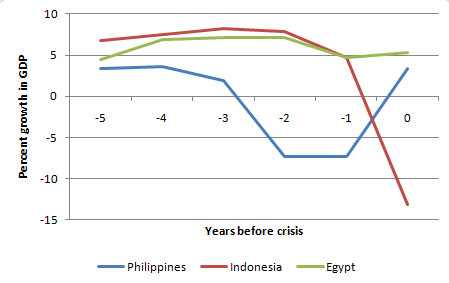
A quick thought about the Egyptian uprising. Many people have sought parallels either in the Philippines 1986 or in Indonesia 1998. But there is a possibly important or revealing difference. As the chart above shows, both of those political crises followed on drastic economic crises — Marcos was caught up in the Latin American debt crisis of the 1980s (in some important ways the Philippines was in effect a Latin American economy at the time), Suharto in the Asian financial crisis. Nothing comparable for Egypt now.

Which is not to say that economics had nothing to do with it. Egypt had decent growth — but the gains weren’t trickling down, and youth unemployment was and is a huge problem.

The moral is that GDP isn’t the whole story. Yes, sensible people already knew that, but this is a graphic reminder.

The toppling of dictator Ben Ali in Tunisia in the wake of mass protests and bloody street clashes has been widely recognized as signifying a major transformation in the future of politics and geopolitics for the major countries of the Middle East and North Africa (MENA). There is little doubt that the Tunisian experience triggered the escalation of unprecedented protests in Egypt against the Mubarak regime. The question on every media pundit’s lips is, ‘Will events in Tunisia and Egypt have a domino effect throughout the Arab world?’

The potential fall of Hosni Mubarak is serious stuff. As The Economist points out, Egypt is “the most populous country in the Arab world”, viewed by the U.S., Britain and West as “a strategic pivot” and a “a vital ally” in the ‘War on Terror’. No wonder then that activists across the world are holding their breath in anticipation that one of the world’s most notorious dictators, and one of the West’s most favoured client-regimes, might be overthrown.

What is happening in Tunisia and Egypt, however, is only a manifestation of a deeper convergence of fundamental structural crises which are truly global in scale. The eruption of social and political unrest has followed the impact of deepening economic turbulence across the region, due to the inflationary impact of rocketing fuel and food prices. As of mid-January, even before Ben Ali had fled Tunis, riots were breaking out in Algeria, Morocco, Yemen and Jordan – the key grievances? Rampant unemployment, unaffordable food and consumer goods, endemic poverty, lack of basic services, and political repression.

We have all been reading about Egypt in the newspapers, and wonder what is behind their problems. Let me offer a few insights.

At least part of Egypt’s problem is the fact that in the past the government has threatened to reduce food subsidies. Now it is planning to hold food subsidies level and raise energy subsidies , but it is not clear that the dollar amount of subsidy will be enough. The government is taking steps to make food and energy affordable for most, but there is worry that the steps being taken will not be enough.

Egypt’s Declining Financial Situation

There is a good reason why one might expect Egypt to start running into problems with energy and food subsidies. Its own financial situation is declining at the same time that the cost of food imports is soaring.

Starting about 2010 or 2011, Egypt will change from an oil exporting nation to an oil importing nation, if there are imports available on the world market. The catch is that Egypt isn’t the only one with declining oil production–world oil production has been approximately flat since 2005, and the countries that produce the oil are using more and more of it themselves. The result is that there is less oil available for export, even as countries like Egypt need more.

The oil that Egypt exports provides funds for the subsidies that it offers, so reduced exports mean less funds are available for subsidies. Egypt has recently been able to ramp up natural gas exports, and these exports have allowed subsidies to remain in place.

Other Budget Pressures

Based on information from the CIA World Fact Book, Egypt was already significantly overspending its revenue in 2009 (the last year available), with revenues of $46.82 billion and expenditures of $64.19 billion. For 2010, the Factbook reports government debt amounting to 80.5% of GDP, putting its debt level far above that of most other African and Arab nations.

If Egypt’s oil production is down, follow-on industries like refining and chemical products are likely down as well, making it difficult to increase revenues from these sources, or to obtain additional taxes related to the spending of workers in these industries. The Suez Canal is one of Egypt’s sources of revenues, but with world oil exports down, revenues from it are likely dropping as well.

Cutbacks in oil production and in Suez Canal transport can be expected to exacerbate unemployment problems. The Egyptian unemployment rate was listed at 9.7% in 2010 by the CIA World Factbook.

Egypt has a history of a fairly egalitarian approach to distribution of income. In 2001, the CIA Factbook lists its GINI coefficient as 34.4%, which is near that of the United Kingdom, and much better than, say, that of the US. But in recent years, the CIA Factbook says Cairo from 2004 to 2008 aggressively pursued economic reforms to attract foreign investment and facilitate GDP growth.

These economic reforms likely raised the income of some people, but not of everyone, creating a wider gap between the rich and poor. This may lie behind reports of concerns by the poor that they are falling farther behind economically. With the county’s history of a more even income distribution and the recent rise in food prices, this rising income inequality may be becoming more of an issue.

Need for Food Imports

Egypt is reported to be the world’s largest importer of wheat. In 2010, Egypt imports 40% of its food, and 60% of its wheat. The problem this year is that world wheat production is down (at least in part due to weather problems in Russia) so world exports are down.

The higher food prices contribute to the overall inflation problem that Egypt already had. In 2010, the CIA Factbook estimated the inflation rate to be 12.8%. Since wages don’t always rise to match inflation rates, inflationary pressures have no doubt put more pressure on the government to increase subsidies, at a time it cannot really afford to do so.

Impact on the Rest of the World

Why does everyone else respond so strongly to Egypt’s problems?

One reason is that other Arab countries are also feeling some of the same pressures. Food prices are rising everywhere. Many low income people spend in excess of 50% of their income for food, so a rise in food costs becomes a real issue. People have come to depend on oil and food subsidies. If they are taken away, or not raised sufficiently to compensate for the higher costs of imports, it is a real problem.

Oil prices seem to be affected as well. If the Suez Canal should be closed because of disruptions, it could affect oil transit, particularly to Europe.

Lessons to Malaysia

Although Malaysia is currently experiencing 6% GDP thus trying to make economic reforms by reducing subsidies, higher income economies, introducing many EPPs and other measures there will be time when Malaysia will change from an oil exporting nation to an oil importing nation, problems will arise.

Tuesday, February 1, 2011

Kenapa Rakyat Mesir Bangkit Menentang Hosni Mubarak? Lessons To Najib

Egyptian Nobel Peace laureate and democracy advocate Mohamed ElBaradei addresses the crowd at Tahrir Square in Cairo, Sunday Jan.30, 2011.
Bakal Presiden baru Mesir yang membawa kebangkitan aspirasi rakyat, Mohamed El-Baradei bekas Pengarah Agensi Tenaga Atom Antarabangsa PBB dan pemenang Novel Peace Prize 2005.

Amr Hamzawi dari Carnegie Endowment Global Think Tank mengariskan lima  sebab kenapa rakyat Mesir bangkit menentang Presiden Hosni Mubarak. WZWH berpendapat lima sebab ini perlu dikaji sebagai panduan, pedoman dan pengajaran kepada DS Najib PM Malaysia yang juga Pengerusi BN dan Presiden UMNO.

Amr Hamzawi menulis....

The Egyptian protests on Tuesday were extraordinary. The geographic extent of the popular protests—unprecedented since the 1970s—and the sheer number of participating citizens made it a critical day. There are five simple factors that distinguish the Egyptian “Day of Anger” from any other day of protest.

First, the timing was inspired by the Jasmine Revolution in Tunisia. The unrest in Tunisia prompted citizens in other Arab countries, such as Algeria, Jordan, and Yemen, to take to the streets demanding their economic, social, and political rights. There was an expectation that the uprising might loosen the grip of security apparatuses on the citizens of other Arab countries, and this became a reality as the Egyptian protests emerged as the most profound byproduct of the great Tunisian revolution. 

The Day of Anger coincided with the annual holiday commemorating the heroism of police officers who confronted British occupation forces in 1952. The timing highlights the contradiction between the original role tasked to the police—defending the nation and protecting citizens without discrimination—with the one it now plays. Today, the security apparatus, particularly under the auspices of emergency law, commits human rights violations, represses and tortures opposition members, political activists, and on many other occasions, ordinary citizens.

Second, the citizens’ protests in Egypt were purely driven by domestic demands. No signs read “death to Israel, America, and global imperialism” or “together to free Palestine and Iraq.” In the streets of Cairo, Alexandria, and Suez, the only slogans heard demanded change, freedom, social justice, and a stop to corruption in Egypt. The differences with protests following major regional events—the invasion of Iraq in 2003, war in Lebanon in 2006, and war over Gaza in 2008-2009—are markedly clear. Egyptian demands for reform and democracy were too often mixed with regional matters, particularly Israeli and U.S. policy in the Middle East. 

Egyptians are rediscovering the real meaning of politics: politics, before anything else, is concern about citizens’ living conditions within the borders of the relevant nation-state. The Jasmine Revolution and all current protests in other Arab countries are displaying the same realistic and mature inclination toward domestic concerns—they are prioritizing local issues over regional ones.

Third, there was a complete absence of the ideological rhetoric that has dominated Egypt’s political and public space for many years. While the Muslim Brotherhood youth and some of their leaders participated in the protests, there were no signs saying, “Islam is the solution.” Similarly, activists from small leftist organizations attended, but the usual denunciations of global imperialism, colonialism, and Zionism were absent. 

There have been signs for years that ideology is less effective in recruiting and mobilizing citizens. Two reasons for this stand out. One, party and non-party forces using ideological rhetoric—namely the Muslim Brotherhood and some leftist activists—have failed to realize socioeconomic change and true political reform. In the wake of the parliamentary elections in 2010, they all appeared to be in a position of weakness and crisis that sharply limited the attractiveness of their messages in Egypt. And two, this week’s protests were organized by youth movements and organizations free of an ideological component. They were able to effectively recruit in the virtual world through social media—the groups succeeded in organizing people to participate using their own voice and language to demand socioeconomic and political change.

Fourth, there was a record presence of youth in the protests. Egyptians have grown accustomed to the same political forces and opposition personalities in the streets—they paid little attention to sit-ins and strikes by the odd group of laborers here or state employees there. But this fundamentally changed. True, the youth of parties and opposition movements that boycotted or withdrew from the parliamentary elections participated in the protests—including from Al-Ghad, Democratic Front, Wafd, and Muslim Brotherhood. But it was the youth unaffiliated with any political movement that formed the greatest bloc among the protestors’ ranks. 

This is clear evidence that the recruitment and mobilization efforts of youth movements and societies have succeeded in bridging the gulf between activists and the youth of the general public. It also demonstrates the power of virtual networking in effectively mobilizing society. While it is true that there is a considerable gap in the number of those involved in online movements—such as the April 6 Youth Movement—and those actually protesting, the involvement of youth is still a welcome and dynamic development regardless of what transpires in the coming days.

Fifth, the demands on bread and butter issues were combined with calls for specific political reforms and measures to combat corruption. This merging of socioeconomic and political issues has long been absent from the protest scene. The reason for this is tied to contempt by some political forces that label socioeconomic demands as classist. Also, those citizens who did protest poor living conditions distrusted the opposition and worried that their demands could be politicized against their better interest. 

Sustaining this integration will deprive the regime of one of its preferred tools for maintaining order: by detaching socioeconomic demands from political ones, the regime can manage popular discontent by making partial concessions on the former while arbitrarily dismissing the latter. A direct and effective mix of the two components should continue. If opposition parties and movements are then able to translate the mixture into specific proposals, the regime will find itself facing a comprehensive set of demands seeking “a better nation for us all.” 

The leaders of Al-Ghad, Democratic Front, Wafd, and National Society for Change did a good job on Tuesday of embracing protestors’ demands and proposals for implementing them. Namely, they called for the end of the emergency law, the release political detainees, the dissolution of both houses of parliament, new elections, and the prohibition of President Mubarak’s candidacy, after five consecutive presidential terms, in upcoming presidential elections. Still, they neglected the socioeconomic demands that the protestors raised even though they were the predominant factor driving demonstrators into the streets in the first place.

These five characteristics signal that the wall of fear in Egypt has been broken. The protests created an opening for broadened popular participation recognizing that socioeconomic and political demands go together. The regime will fail to see the point by assuming the situation can be managed with repression on some occasions, and partial concessions and vague promises on others. 

Egyptian society is suffering from inadequate living conditions, frightening gap between rich and poor, tensions between Muslims and Copts, and a grave crisis of legitimacy in the wake of the 2010 parliamentary elections. These crises make it imperative that Egypt distances itself from the specter of chaos and allow real reform to begin now.

Kesimpulan yang WZWH boleh buat ialah memang sesuai sangat slogan DS Najib iaitu Rakyat Didahulukan Pencapaian Diutamakan dan 1Malaysia. Itu yang Presiden Hosni Mubarak perlu buat diakhir-akhir pemerintahan lagi. WZWH tidak yakin kuasa Presiden yang akan diperturunkan kepada Gamal anak lelaki Hosni Mubarak akan diterima oleh rakyat Mesir. 

Nampak gayanya Mohamed El-Baradei, bekas Pengarah International Atomic Energy Agency (IAEA) agensi nuklear PBB, pemenang 2005 Nobel Peace Prize dan tokoh yang banyak menyokong pembinaan loji tenaga nuklear dibina di Malaysia besar kemungkinan menjadi Presiden baru Mesir kerana ketokohan dan keilmuan pendidikannya diterima oleh majoriti parti politik dan rakyat Mesir.

Provoking Thought: Konspirasi Politik Lee Kuan Yew Dan UMNO


Dalam politik kita kena juga berfikir "provoking thought" sergah minda pemikiran politik melalui pengamatan dan pemerhatian selama berpuluh tahun. Konspirasi politik Lee Kuan Yew dan UMNO.

Kalau kita perhatikan setiap kali PRU dan PRK di adakan selama lebih 40 tahun acapkali mantan presiden Singapura, Lee Kuan Yew (LKY) kini Menteri Kanan mengeluarkan political statement yang nampak negatif kepada UMNO dan BN serta negara tapi political statement itulah yang selalu memenangkan UMNO dan BN.

Dan dalam pada masa yang sama Tun Mahathir akan turut sama menjawab retorik kenyataan politik LKW. Dalam permainan politik Tun Mahathir, beliau menggunakan isu Melayu dan Islam di Singapura sebagai isu untuk menyatukan orang Melayu Islam untuk terus menyokong kerajaan yang memerintah hari ini. Tun Mahathir sentiasa menjadikan orang Melayu Singapura sebagai contoh dan alat untuk menakutkan orang Melayu di Malaysia supaya jangan menerima parti lain selain dari UMNO dan BN jika Melayu masih mahukan masa depan mereka tidak menerima nasib seperti Melayu Singapura.

UMNO/BN berjaya mengalahkan PAS/PR dalam PRK DUN Tenang dan seterusnya menambahkan lagi majoriti yang dimenanginya pada 2008 yang lalu. Banyak faktor-faktor kemenangan yang dimiliki oleh Umno akan dihuraikan oleh pelbagai penganalisa politik nanti.

Maka disini satu persoalan yang sedang belegar-legar dikepala adakah berkemungkinan faktor penyumbang peningkatan didorong oleh suara dari seberang tambak iaitu LKW. Adakah LKW terbabit sama di dalam kempen UMNO untuk memenangi PRK DUN Tenang?

Apakah sesudah MCA gagal untuk meyakinkan kepada pengundi kaum Cina dengan isu Negara Islam PAS dan isu "salam sarung tangan" calon muslimat PAS, UMNO sengaja membiarkan undi kaum cina masuk ke dalam peti undi PAS dan UMNO melalui lidah rasminya Utusan Malaysia berkempen menakutkan Melayu dan seterusnya memaksa Melayu mengundi dacing?

Dan jangan dilupakan DUN Tenang ini berada didalam Negeri Johor bersempadanan dengan Singapura pula?

laporan akhbar dari Utusan Malaysia pada 27.1.11 dimana tertera nama Menteri Mentor Singpura dimuka hadapan akhbar itu - BERITA UTAMA; KUAN YEW TAKUT NEGARA JIRAN

Pada 28.1.11 didalam laporan akhbar yang sama nama LKW naik lagi dan pada tarikh tersebut laporan mengenainya dipaparkan diruang RENCANA ; ANTARA MCA,DAP DAN LEE KUAN YEW

Dan paling mengujakan hati ini apabila disaat-saat akhir sebelum pintu pusat pengundian dibuka pada 30.1.11 BN melalui media rasmi UMNO iaitu Utusan Malaysia melancarkan laporan muka hadapan - BERITA UTAMA; KUAN YEW KETEPIKAN AGAMA 

Jelas dan terang UMNO berjaya di dalam kempennya untuk menarik perhatian pengundi Melayu dengan menggunakan LKW sebagai umpan apatahlagi peningkatan undi dari kaum Melayu sehingga melonjakan majoriti yang diperolehi lebih dari 1000 undi berbanding 2008.

Kenapa kempen percuma dari LKW ini sangat berharga buat BN/UMNO?

Sebagaimana biasanya, apa sahaja yang diperkatakan Menteri Mentor Singapura, LKW, tentang politik Malaysia mahupun tentang hubungan Malaysia-Singapura akan menimbulkan reaksi gempar dikalangan rakyat umum di Malaysia.

LKW sering dianggap sebagai realiti yang lebih besar daripada kehidupan ini sendiri. Dalam kerangka wacana politik negara ini yang begitu tebal ciri perkauaman-misalnya dikalangan orang-orang UMNO-LKW sering digambarkan sebagai musuh ketat lagi berbahaya.

Nasib orang Melayu Singapura,dan penindasan mereka oleh LKW dan kerajaan Singapura,sering dikemukakan sebagai contoh dan amaran tentang apa yang akan terjadi kepada orang Melayu jika kuasa politik terlepas dari tangan orang Melayu-maksudnya terlepas dari tangan UMNO-dan direbut oleh LKW dan kaumnya.

Pemimpin politik yang bersikap perkauman di Malaysia-akan memperalatkan negara jiran terdekat mereka sama seperti negara Israel memperalatkan peristiwa Holocaust; yakni untuk membela kewujudannya dan mencipta momok asing yang dikatakan akan membahayakan kewujudan itu Malaysia.

Samada LKW ini benar-benar salah satu kempen yang paling berjaya buat UMNO kemenangan di PRK DUN Tenang bukanlah BN yang menang tetapi UMNO yang menjadi Juaranya.

kepercayaan bahawa LKW akan berterusan menjadi bahan kempen percuma untuk BN akan berterusan sehinggalah LKW menutup mata. 

Dalam pemikiran LKW walaupaun beliau teruja dengan idea kebangkitan PR memerintah Malaysia tapi dari segi jangka panjang LKW tahu kestabilan dan keamanan politik Malaysia tidak akan bertahan lama jika PR memerintah dan ini boleh memberi kesan secara lansung kepada Singapura sebab itu LKW dan Tun Mahathir tahu apa drama, apa polemik dan apa retorik untuk memastikan UMNO dan BN berkuasa memerintah Malaysia hingga rakyat pada satu masa akan datang akan memilih parti alternatif lain. Itu beratus tahun lagilah terlalu awal untuk dibuat analisa!

Analisis Pengundi Cina PRK DUN Tenang


WZWH sebagai saintis politik suka melihat data dan "empirical evidence" bagi membuat analisis trend "vote behaviour" perlakuan kecenderongan pengundi Cina di DUN Tenang. Dun Tenang dalam parlimen Labis yang disandang anak presisen MCA. Maka Labis ini kubu kuat CSL.

Mari kita lihat analisis keputusan PRK DUN Tenang:

Terdapat tiga pusat mengundi di DUN Tenang majoritinya masyarakat China. Labis, Labis Tengah dan Labis Timur. Berikut adalah keputusan di tiga pusat mengundi tersebut :

LABIS
Keluar mengundi 53.0 % 
BN 380 undi
Pas 337 undi
Majoriti 43 undi

LABIS TENGAH
Keluar mengundi 30.0 %
BN 365 undi
Pas 851 undi
Majoriti negatif BN kalah 486 undi

LABIS TIMUR
Keluar mengundi 51.4 % 
BN 669 undi
Pas 632 undi
Rosak 16
Majoriti 37 undi

Kehadiran keluar mengundi di tiga pusat mengundi semuanya dibawah 53% tidak memuaskan. Alasan hujan tidak boleh diterima. Jika orang Cina menyokong BN sudah tentu pasti lebih 75% keluar mengundi dengan bersemangat. Sememangnya di mana-mana PRU dan PRK orang Cina paling ramai keluar mengundi.

Adakah jentera MCA tidak berkerja lebih kuat untuk membantu menggerakkan sokongan kepada BN? Jawapan dari data menunjukkan MCA tidak bersungguh-sungguh. Adakah jentera komponen BN lain terlibat sama?

Jumlah yang keluar mengundi dari tiga pusat mengundi itu ialah 3,250.  BN mendapat 1,414 undi Pas 1,836 undi. BN tewas di tiga peti undi itu 422 undi. Dengan andaian lebih 70% keluar mengundi maka BN dijangka kalah sekitar 1000 undi di tiga pusat mengundi tersebut.

Dari data tersebut WZWH boleh buat kesimpulan ramai pengundi Cina tidak keluar mengundi kerana rasa serba salah dengan pilihan mereka. Labis adalah tempat presiden MCA. Labis menjadi tumpuan teropong DS Najib dan TS Muhyiddin Yassin. Maka lebih baik orang Cina ramai tidak keluar mengundi dari memalukan BN dan tidak mahu arah kecenderongan mereka  diketahui.

WZWH akui tindakan ramai orang Cina tidak keluar mengundi ini turut membantu kemenangan calon BN dengan tidak mengundi PAS. Sedangkan PR terutama DAP sangat mengharap sokongan orang Cina Labis.

Terlalu kuat isu perkauman yang dihasut oleh pihak lawan dengan model kejayaan di Selangor, Pulau Pinang, Wilayah Persekutuan, dan Perak hingga menyebabkan pengundi China menjadi serba salah untuk keluar mengundi akhirnya sebilangan besar tidak mengundi.

Keyakinan kepada MCA masih berbelah bagi. MCA tidak dapat meyakinkan masyarakat China agar menambah sokongan kepada BN. Masyarakat China juga sebahagiannya begitu percaya kepada janji-janji manis PR  jika mereka dapat mengambil alih Putrajaya.

Trend sokongan masyarakat China terhadap BN antara 35 ke 45% adalah lebih berasas dan benar. Jika begitu keadaanya, BN dalam kedudukan yang masih lagi tidak setabil untuk menghadapi PRU 13. Peratusan itu terlalu sensitif iaitu kurang dari 50%.

DS Najib kena akui inilah hakikatnya sokongan pengundi Cina di seluruh Malaysia. Kalau BN mahu menang PRU 13, BN perlu dapat sokongan 65% orang Melayu dan Bumiputera, 60% orang India dan cuba dapatkan 45% orang Cina.

[Autosaved] WZWH Mula Menulis…

Sudah lama WZWH tidak berblog WZWH mula menulis… Sekarang Perang US-Israel VS Iran. Ganggu keamanan dan ekonomi dunia Sudah tentu beri kesan...